

2025 Updated Verified Databricks-Certified-Data-Engineer-Associate Downloadable Printable Exam Dumps
The Ultimate Databricks Databricks-Certified-Data-Engineer-Associate Dumps PDF Review
The GAQM Databricks-Certified-Data-Engineer-Associate (Databricks Certified Data Engineer Associate) Certification Exam is a prestigious certification exam that is designed for professionals who have experience in designing and implementing big data solutions using Databricks platform. Databricks Certified Data Engineer Associate Exam certification exam is ideal for data engineers, architects, developers, and data scientists who want to demonstrate their skills and knowledge in working with Databricks for big data processing and analytics.
The GAQM Databricks-Certified-Data-Engineer-Associate (Databricks Certified Data Engineer Associate) Exam is a certification that is designed to test the skills and knowledge of data engineers who work with Databricks. Data engineers play a critical role in any organization that relies on data to make decisions. They are responsible for the design, construction, and maintenance of data pipelines, data models, and data warehouses.
The Databricks Databricks-Certified-Data-Engineer-Associate exam consists of 60 multiple-choice questions that must be completed in 90 minutes. The passing score for the exam is 70%, and candidates who pass the exam will receive a certificate that validates their knowledge and expertise in Databricks. Databricks Certified Data Engineer Associate Exam certification is recognized globally and is a valuable asset for data engineers who want to advance their careers and demonstrate their proficiency in Databricks.
NEW QUESTION # 58
A dataset has been defined using Delta Live Tables and includes an expectations clause:
CONSTRAINT valid_timestamp EXPECT (timestamp > '2020-01-01') ON VIOLATION FAIL UPDATE What is the expected behavior when a batch of data containing data that violates these constraints is processed?
- A. Records that violate the expectation are added to the target dataset and recorded as invalid in the event log.
- B. Records that violate the expectation are dropped from the target dataset and loaded into a quarantine table.
- C. Records that violate the expectation cause the job to fail.
- D. Records that violate the expectation are added to the target dataset and flagged as invalid in a field added to the target dataset.
- E. Records that violate the expectation are dropped from the target dataset and recorded as invalid in the event log.
Answer: C
Explanation:
Explanation
https://docs.databricks.com/en/delta-live-tables/expectations.html
Action
Result
warn (default)
Invalid records are written to the target; failure is reported as a metric for the dataset.
drop
Invalid records are dropped before data is written to the target; failure is reported as a metrics for the dataset.
fail
Invalid records prevent the update from succeeding. Manual intervention is required before re-processing.
NEW QUESTION # 59
Which of the following commands can be used to write data into a Delta table while avoiding the writing of duplicate records?
- A. IGNORE
- B. APPEND
- C. INSERT
- D. MERGE
- E. DROP
Answer: D
Explanation:
The MERGE command can be used to upsert data from a source table, view, or DataFrame into a target Delta table. It allows you to specify conditions for matching and updating existing records, and inserting new records when no match is found. This way, you can avoid writing duplicate records into a Delta table1. The other commands (DROP, IGNORE, APPEND, INSERT) do not have this functionality and may result in duplicate records or data loss234. Reference: 1: Upsert into a Delta Lake table using merge | Databricks on AWS 2: SQL DELETE | Databricks on AWS 3: SQL INSERT INTO | Databricks on AWS 4: SQL UPDATE | Databricks on AWS
NEW QUESTION # 60
Which query is performing a streaming hop from raw data to a Bronze table?
- A.
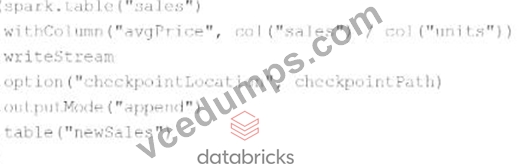
- B.
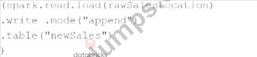
- C.
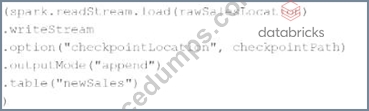
- D.
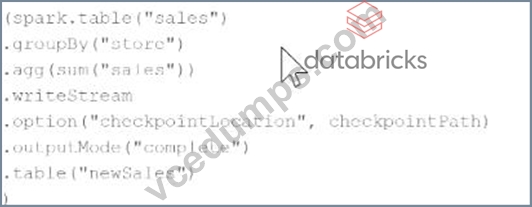
Answer: C
NEW QUESTION # 61
Which of the following describes a scenario in which a data engineer will want to use a single-node cluster?
- A. When they are running automated reports to be refreshed as quickly as possible
- B. When they are concerned about the ability to automatically scale with larger data
- C. When they are manually running reports with a large amount of data
- D. When they are working interactively with a small amount of data
- E. When they are working with SQL within Databricks SQL
Answer: D
Explanation:
The scenario in which a data engineer will want to use a single-node cluster is when they are working interactively with a small amount of data. A single-node cluster is a cluster consisting of an Apache Spark driver and no Spark workers1. A single-node cluster supports Spark jobs and all Spark data sources, including Delta Lake1. A single-node cluster is helpful for single-node machine learning workloads that use Spark to load and save data, and for lightweight exploratory data analysis1. A single-node cluster can run Spark locally, spawn one executor thread per logical core in the cluster, and save all log output in the driver log1. A single-node cluster can be created by selecting the Single Node button when configuring a cluster1.
The other options are not suitable for using a single-node cluster. When running automated reports to be refreshed as quickly as possible, a data engineer will want to use a multi-node cluster that can scale up and down automatically based on the workload demand2. When working with SQL within Databricks SQL, a data engineer will want to use a SQL Endpoint that can execute SQL queries on a serverless pool or an existing cluster3. When concerned about the ability to automatically scale with larger data, a data engineer will want to use a multi-node cluster that can leverage the Databricks Lakehouse Platform and the Delta Engine to handle large-scale data processing efficiently and reliably4. When manually running reports with a large amount of data, a data engineer will want to use a multi-node cluster that can distribute the computation across multiple workers and leverage the Spark UI to monitor the performance and troubleshoot the issues.
Reference:
1: Single Node clusters | Databricks on AWS
2: Autoscaling | Databricks on AWS
3: SQL Endpoints | Databricks on AWS
4: Databricks Lakehouse Platform | Databricks on AWS
5: [Spark UI | Databricks on AWS]
NEW QUESTION # 62
A data engineer that is new to using Python needs to create a Python function to add two integers together and return the sum?
Which of the following code blocks can the data engineer use to complete this task?
- A.

- B.

- C.

- D.

- E.

Answer: D
Explanation:
Explanation
https://www.w3schools.com/python/python_functions.asp
NEW QUESTION # 63
A data engineer has a Job that has a complex run schedule, and they want to transfer that schedule to other Jobs.
Rather than manually selecting each value in the scheduling form in Databricks, which of the following tools can the data engineer use to represent and submit the schedule programmatically?
- A. pyspark.sql.types.DateType
- B. datetime
- C. There is no way to represent and submit this information programmatically
- D. pyspark.sql.types.TimestampType
- E. Cron syntax
Answer: E
Explanation:
Cron syntax is a tool that can be used to represent and submit a complex run schedule programmatically. Cron syntax is a string of six fields that specify the frequency, date, and time of a job run. For example, the cron expression 0 0 12 * * ? means run the job at 12:00 PM every day. The data engineer can use the Databricks REST API to create or update a job with a cron schedule. The data engineer can also use the Databricks CLI to create or update a job with a cron schedule by using a JSON file that contains the cron expression. The other tools are either invalid or not suitable for representing and submitting a complex run schedule programmatically. References: Schedule a job, Jobs API, Databricks CLI, Cron expressions
NEW QUESTION # 64
Which of the following describes a benefit of creating an external table from Parquet rather than CSV when using a CREATE TABLE AS SELECT statement?
- A. CREATE TABLE AS SELECT statements cannot be used on files
- B. Parquet files can be partitioned
- C. Parquet files will become Delta tables
- D. Parquet files have the ability to be optimized
- E. Parquet files have a well-defined schema
Answer: E
Explanation:
Explanation
https://www.databricks.com/glossary/what-is-parquet#:~:text=Columnar%20storage%20like%20Apache%20Par Columnar storage like Apache Parquet is designed to bring efficiency compared to row-based files like CSV.
When querying, columnar storage you can skip over the non-relevant data very quickly. As a result, aggregation queries are less time-consuming compared to row-oriented databases.
NEW QUESTION # 65
A data engineer only wants to execute the final block of a Python program if the Python variable day_of_week is equal to 1 and the Python variable review_period is True.
Which of the following control flow statements should the data engineer use to begin this conditionally executed code block?
- A. if day_of_week == 1 and review_period == "True":
- B. if day_of_week = 1 & review_period: = "True":
- C. if day_of_week == 1 and review_period:
- D. if day_of_week = 1 and review_period = "True":
- E. if day_of_week = 1 and review_period:
Answer: C
Explanation:
In Python, the == operator is used to compare the values of two variables, while the = operator is used to assign a value to a variable. Therefore, option A and E are incorrect, as they use the = operator for comparison.
Option B and C are also incorrect, as they compare the review_period variable to a string value "True", which is different from the boolean value True. Option D is the correct answer, as it uses the == operator to compare the day_of_week variable to the integer value 1, and the and operator to check if both conditions are true. If both conditions are true, then the final block of the Python program will be executed. References: [Python Operators], [Python If ... Else]
NEW QUESTION # 66
A new data engineering team team has been assigned to an ELT project. The new data engineering team will need full privileges on the table sales to fully manage the project.
Which of the following commands can be used to grant full permissions on the database to the new data engineering team?
- A. GRANT ALL PRIVILEGES ON TABLE team TO sales;
- B. GRANT SELECT ON TABLE sales TO team;
- C. GRANT SELECT CREATE MODIFY ON TABLE sales TO team;
- D. GRANT USAGE ON TABLE sales TO team;
- E. GRANT ALL PRIVILEGES ON TABLE sales TO team;
Answer: E
Explanation:
To grant full permissions on a table to a user or a group, you can use the GRANT ALL PRIVILEGES ON TABLE statement. This statement will grant all the possible privileges on the table, such as SELECT, CREATE, MODIFY, DROP, ALTER, etc. Option A is the only code block that follows this syntax correctly. Option B is incorrect, as it does not grant all the possible privileges on the table, but only a subset of them. Option C is incorrect, as it only grants the SELECT privilege on the table, which is not enough to fully manage the project. Option D is incorrect, as it grants the USAGE privilege on the table, which is not a valid privilege for tables. Option E is incorrect, as it grants all the privileges on the table team to the user or group sales, which is the opposite of what the question asks. Reference: Grant privileges on a table using SQL | Databricks on AWS, Grant privileges on a table using SQL - Azure Databricks, SQL Privileges - Databricks
NEW QUESTION # 67
A data engineer needs access to a table new_uable, but they do not have the correct permissions. They can ask the table owner for permission, but they do not know who the table owner is.
Which approach can be used to identify the owner of new_table?
- A. There is no way to identify the owner of the table
- B. Review the Owner field in the table's page in Data Explorer
- C. Review the Permissions tab in the table's page in Data Explorer
- D. Review the Owner field in the table's page in the cloud storage solution
Answer: B
Explanation:
To find the owner of a table in Databricks, one can utilize the Data Explorer feature. The Data Explorer provides detailed information about various data objects, including tables. By navigating to the specific table's page in Data Explorer, a data engineer can review the Owner field, which identifies the individual or role that owns the table. This information is crucial for obtaining the necessary permissions or for any administrative actions related to the table.
Reference:
Databricks documentation on Data Explorer: Using Data Explorer in Databricks
NEW QUESTION # 68
A data analyst has created a Delta table sales that is used by the entire data analysis team. They want help from the data engineering team to implement a series of tests to ensure the data is clean. However, the data engineering team uses Python for its tests rather than SQL.
Which of the following commands could the data engineering team use to access sales in PySpark?
- A. spark.table("sales")
- B. SELECT * FROM sales
- C. spark.sql("sales")
- D. spark.delta.table("sales")
- E. There is no way to share data between PySpark and SQL.
Answer: D
NEW QUESTION # 69
A data engineer has three tables in a Delta Live Tables (DLT) pipeline. They have configured the pipeline to drop invalid records at each table. They notice that some data is being dropped due to quality concerns at some point in the DLT pipeline. They would like to determine at which table in their pipeline the data is being dropped.
Which of the following approaches can the data engineer take to identify the table that is dropping the records?
- A. They cannot determine which table is dropping the records.
- B. They can navigate to the DLT pipeline page, click on the "Error" button, and review the present errors.
- C. They can set up DLT to notify them via email when records are dropped.
- D. They can set up separate expectations for each table when developing their DLT pipeline.
- E. They can navigate to the DLT pipeline page, click on each table, and view the data quality statistics.
Answer: B
NEW QUESTION # 70
A data engineer is working with two tables. Each of these tables is displayed below in its entirety.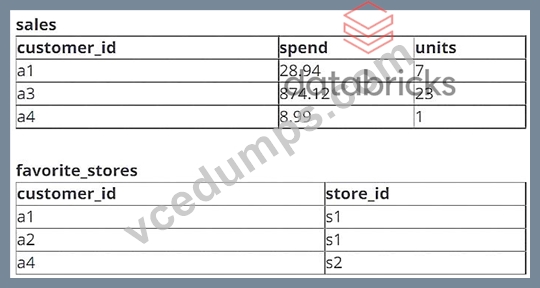
The data engineer runs the following query to join these tables together: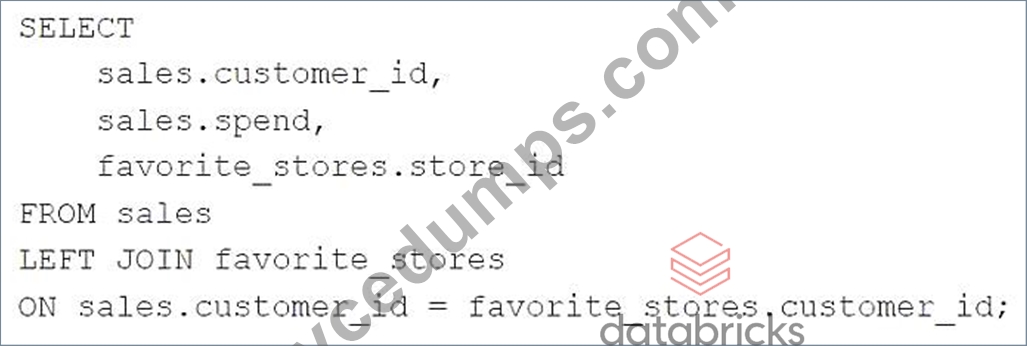
Which of the following will be returned by the above query?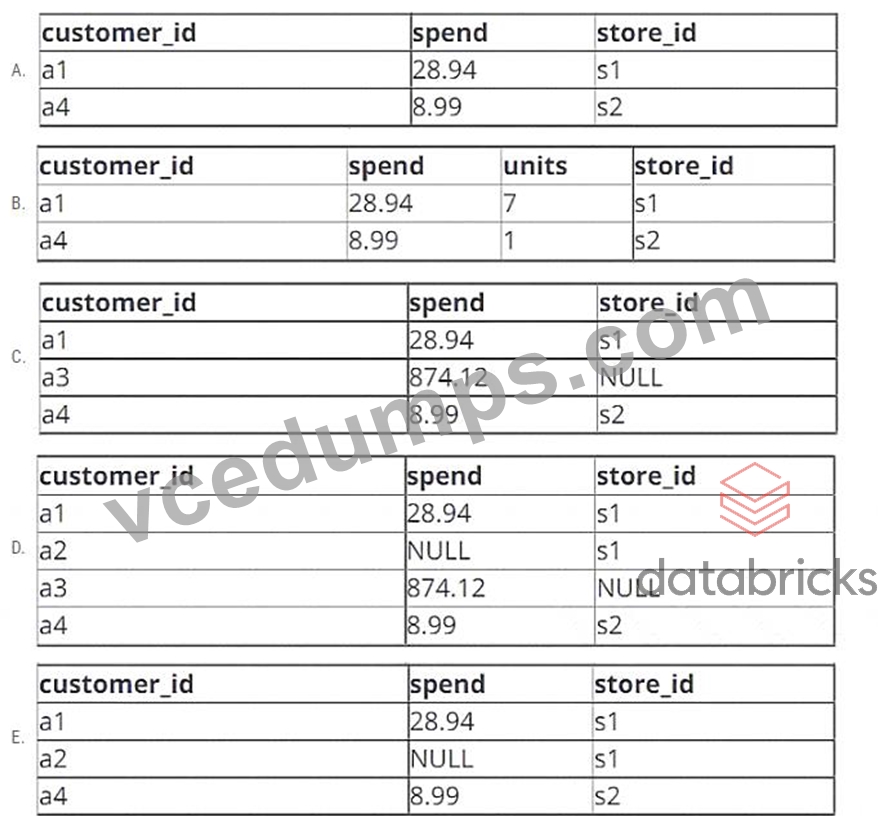
- A. Option C
- B. Option B
- C. Option A
- D. Option E
- E. Option D
Answer: A
NEW QUESTION # 71
Which of the following Git operations must be performed outside of Databricks Repos?
- A. Pull
- B. Clone
- C. Push
- D. Commit
- E. Merge
Answer: E
Explanation:
Databricks Repos is a visual Git client and API in Databricks that supports common Git operations such as commit, pull, push, branch management, and visual comparison of diffs when committing1. However, merge is not supported in the Git dialog2. You need to use the Repos UI or your Git provider to merge branches3. Merge is a way to combine the commit history from one branch into another branch1. During a merge, a merge conflict is encountered when Git cannot automatically combine code from one branch into another. Merge conflicts require manual resolution before a merge can be completed1. References: 4: Run Git operations on Databricks Repos4, 1: CI/CD techniques with Git and Databricks Repos1, 3: Collaborate in Repos3, 2: Databricks Repos - What it is and how we can use it2.
Databricks Repos is a visual Git client and API in Databricks that supports common Git operations such as commit, pull, push, merge, and branch management. However, to clone a remote Git repository to a Databricks repo, you must use the Databricks UI or API. You cannot clone a Git repo using the CLI through a cluster's web terminal, as the files won't display in the Databricks UI1. References: 1: Run Git operations on Databricks Repos | Databricks on AWS2
NEW QUESTION # 72
A data engineer needs to use a Delta table as part of a data pipeline, but they do not know if they have the appropriate permissions.
In which of the following locations can the data engineer review their permissions on the table?
- A. Data Explorer
- B. Jobs
- C. Dashboards
- D. Databricks Filesystem
- E. Repos
Answer: A
NEW QUESTION # 73
A Delta Live Table pipeline includes two datasets defined using STREAMING LIVE TABLE. Three datasets are defined against Delta Lake table sources using LIVE TABLE.
The table is configured to run in Development mode using the Continuous Pipeline Mode.
Assuming previously unprocessed data exists and all definitions are valid, what is the expected outcome after clicking Start to update the pipeline?
- A. All datasets will be updated once and the pipeline will persist without any processing. The compute resources will persist but go unused.
- B. All datasets will be updated once and the pipeline will shut down. The compute resources will persist to allow for additional testing.
- C. All datasets will be updated once and the pipeline will shut down. The compute resources will be terminated.
- D. All datasets will be updated at set intervals until the pipeline is shut down. The compute resources will persist until the pipeline is shut down.
- E. All datasets will be updated at set intervals until the pipeline is shut down. The compute resources will persist to allow for additional testing.
Answer: D
Explanation:
The Continuous Pipeline Mode for Delta Live Tables allows the pipeline to run continuously and process data as it arrives. This mode is suitable for streaming ingest and CDC workloads that require low-latency updates.
The Development mode for Delta Live Tables allows the pipeline to run on a dedicated cluster that is not shared with other pipelines. This mode is useful for testing and debugging the pipeline logic before deploying it to production. Therefore, the correct answer is B, because the pipeline will run continuously on a dedicated cluster until it is manually stopped, and the compute resources will be released only after the pipeline is shut down. References: Databricks Documentation - Configure pipeline settings for Delta Live Tables, Databricks Documentation - Continuous vs. triggered pipeline execution, Databricks Documentation - Development vs.
production mode.
NEW QUESTION # 74
A data engineer only wants to execute the final block of a Python program if the Python variable day_of_week is equal to 1 and the Python variable review_period is True.
Which of the following control flow statements should the data engineer use to begin this conditionally executed code block?
- A. if day_of_week == 1 and review_period == "True":
- B. if day_of_week = 1 & review_period: = "True":
- C. if day_of_week = 1 and review_period = "True":
- D. if day_of_week = 1 and review_period:
- E. if day_of_week == 1 and review_period:
Answer: A
NEW QUESTION # 75
A data engineer has a Python notebook in Databricks, but they need to use SQL to accomplish a specific task within a cell. They still want all of the other cells to use Python without making any changes to those cells.
Which of the following describes how the data engineer can use SQL within a cell of their Python notebook?
- A. They can attach the cell to a SQL endpoint rather than a Databricks cluster
- B. They can change the default language of the notebook to SQL
- C. It is not possible to use SQL in a Python notebook
- D. They can simply write SQL syntax in the cell
- E. They can add %sql to the first line of the cell
Answer: E
NEW QUESTION # 76
A data engineer is maintaining a data pipeline. Upon data ingestion, the data engineer notices that the source data is starting to have a lower level of quality. The data engineer would like to automate the process of monitoring the quality level.
Which of the following tools can the data engineer use to solve this problem?
- A. Unity Catalog
- B. Auto Loader
- C. Delta Lake
- D. Delta Live Tables
- E. Data Explorer
Answer: D
Explanation:
Delta Live Tables is a tool that enables data engineers to build and manage reliable data pipelines with minimal code. One of the features of Delta Live Tables is data quality monitoring, which allows data engineers to define quality expectations for their data and automatically check them at every step of the pipeline. Data quality monitoring can help detect and resolve data quality issues, such as missing values, duplicates, outliers, or schema changes. Data quality monitoring can also generate alerts and reports on the quality level of the data, and enable data engineers to troubleshoot and fix problems quickly. Reference: Delta Live Tables Overview, Data Quality Monitoring
NEW QUESTION # 77
A data engineer is using the following code block as part of a batch ingestion pipeline to read from a composable table: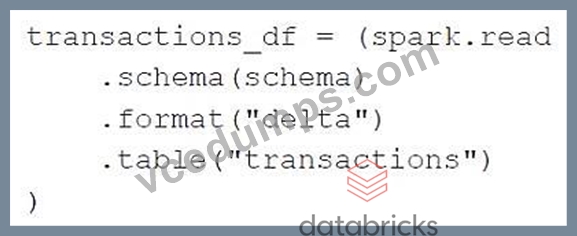
Which of the following changes needs to be made so this code block will work when the transactions table is a stream source?
- A. Replace format("delta") with format("stream")
- B. Replace "transactions" with the path to the location of the Delta table
- C. Replace predict with a stream-friendly prediction function
- D. Replace spark.read with spark.readStream
- E. Replace schema(schema) with option ("maxFilesPerTrigger", 1)
Answer: D
Explanation:
Explanation
https://docs.databricks.com/en/structured-streaming/delta-lake.html
NEW QUESTION # 78
A data engineer needs to create a table in Databricks using data from their organization's existing SQLite database.
They run the following command: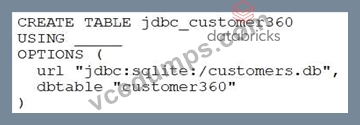
Which of the following lines of code fills in the above blank to successfully complete the task?
- A. org.apache.spark.sql.jdbc
- B. DELTA
- C. autoloader
- D. sqlite
- E. org.apache.spark.sql.sqlite
Answer: D
Explanation:
In the given command, a data engineer is trying to create a table in Databricks using data from an SQLite database. The correct option to fill in the blank is "sqlite" because it specifies the type of database being connected to in a JDBC connection string. The USING clause should be followed by the format of the data, and since we are connecting to an SQLite database, "sqlite" would be appropriate here. References:
* Create a table using JDBC
* JDBC connection string
* SQLite JDBC driver
NEW QUESTION # 79
Which of the following commands will return the location of database customer360?
- A. USE DATABASE customer360;
- B. ALTER DATABASE customer360 SET DBPROPERTIES ('location' = '/user'};
- C. DESCRIBE DATABASE customer360;
- D. DESCRIBE LOCATION customer360;
- E. DROP DATABASE customer360;
Answer: C
Explanation:
The command DESCRIBE DATABASE customer360; will return the location of the database customer360, along with its comment and properties. This command is an alias for DESCRIBE SCHEMA customer360;, which can also be used to get the same information. The other commands will either drop the database, alter its properties, or use it as the current database, but will not return its location12. Reference:
DESCRIBE DATABASE | Databricks on AWS
DESCRIBE DATABASE - Azure Databricks - Databricks SQL
NEW QUESTION # 80
Which of the following code blocks will remove the rows where the value in column age is greater than 25 from the existing Delta table my_table and save the updated table?
- A. UPDATE my_table WHERE age <= 25;
- B. DELETE FROM my_table WHERE age > 25;
- C. UPDATE my_table WHERE age > 25;
- D. DELETE FROM my_table WHERE age <= 25;
- E. SELECT * FROM my_table WHERE age > 25;
Answer: B
Explanation:
1: The DELETE command in Delta Lake allows you to remove data that matches a predicate from a Delta table. This command will delete all the rows where the value in the column age is greater than 25 from the existing Delta table my_table and save the updated table. The other options are either incorrect or do not achieve the desired result. Option A will only select the rows that match the predicate, but not delete them. Option B will update the rows that match the predicate, but not delete them. Option D will update the rows that do not match the predicate, but not delete them. Option E will delete the rows that do not match the predicate, which is the opposite of what we want. Reference: Table deletes, updates, and merges - Delta Lake Documentation
NEW QUESTION # 81
A data engineer has been using a Databricks SQL dashboard to monitor the cleanliness of the input data to a data analytics dashboard for a retail use case. The job has a Databricks SQL query that returns the number of store-level records where sales is equal to zero. The data engineer wants their entire team to be notified via a messaging webhook whenever this value is greater than 0.
Which of the following approaches can the data engineer use to notify their entire team via a messaging webhook whenever the number of stores with $0 in sales is greater than zero?
- A. They can set up an Alert without notifications.
- B. They can set up an Alert with a custom template.
- C. They can set up an Alert with a new email alert destination.
- D. They can set up an Alert with one-time notifications.
- E. They can set up an Alert with a new webhook alert destination.
Answer: E
Explanation:
A webhook alert destination is a notification destination that allows Databricks to send HTTP POST requests to a third-party endpoint when an alert is triggered. This enables the data engineer to integrate Databricks alerts with their preferred messaging or collaboration platform, such as Slack, Microsoft Teams, or PagerDuty.
To set up a webhook alert destination, the data engineer needs to create and configure a webhook connector in their messaging platform, and then add the webhook URL to the Databricks notification destination. After that, the data engineer can create an alert for their Databricks SQL query, and select the webhook alert destination as the notification destination. The alert can be configured with a custom condition, such as when the number of stores with $0 in sales is greater than zero, and a custom message template, such as "Alert:
{number_of_stores} stores have $0 in sales". The alert can also be configured with a recurrence interval, such as every hour, to check the query result periodically. When the alert condition is met, the data engineer and their team will receive a notification via the messaging webhook, with the custom message and a link to the Databricks SQL query. The other options are either not suitable for sending notifications via a messaging webhook (A, B, E), or not suitable for sending recurring notifications . References: Databricks Documentation -Manage notification destinations, Databricks Documentation - Create alerts for Databricks SQL queries, Databricks Documentation - Configure alert conditions and messages.
NEW QUESTION # 82
......
Achive your Success with Latest Databricks-Certified-Data-Engineer-Associate Exam: https://prep4sure.vcedumps.com/Databricks-Certified-Data-Engineer-Associate-examcollection.html
