

Latest Workday-Prism-Analytics Practice Test Questions Verified Answers As Experienced in the Actual Test!
Pass Workday Workday-Prism-Analytics Exam in First Attempt Easily
NEW QUESTION # 31
You are loading data into a table using the Data Change task. The field type in the source file is Numeric and the table field type is Text. What can you do to load the data?
- A. Use a different source file, as the field types are incompatible.
- B. Map the Numeric field to the table Text field.
- C. Change the field type in the parsing stage from Numeric to Text.
- D. Change the connection type for the data change task.
Answer: B
Explanation:
Comprehensive and Detailed Explanation From Exact Extract:
In Workday Prism Analytics, the Data Change task is used to load data from a source file into a table, and it supports flexible field type mapping to accommodate differences between source and target field types.
According to the official Workday Prism Analytics study path documents, when the source file has a Numeric field type and the target table has a Text field type, you can map the Numeric field to the Text field in the Data Change task. Workday Prism Analytics automatically handles the conversion of Numeric values to Text during the data loading process, as Text fields can store Numeric values as strings without data loss.
The other options are not necessary or appropriate:
* A. Use a different source file, as the field types are incompatible: The field types are not incompatible; Prism supports mapping Numeric to Text, making a new source file unnecessary.
* C. Change the field type in the parsing stage from Numeric to Text: The parsing stage defines how the source file is interpreted, but changing the source field type is not required since the mapping handles the conversion.
* D. Change the connection type for the data change task: The connection type (e.g., file upload or Workday report) is unrelated to field type compatibility and does not address the issue.
By mapping the Numeric field to the Text field in the Data Change task, the data can be successfully loaded, leveraging Prism's built-in type conversion capabilities to ensure compatibility.
References:
Workday Prism Analytics Study Path Documents, Section: Data Prep and Transformation, Topic: Field Type Mapping in Data Change Tasks Workday Prism Analytics Training Guide, Module: Data Prep and Transformation, Subtopic: Handling Field Type Conversions in Data Loading
NEW QUESTION # 32
You are asked to produce a Prism data source, which is going to be used in a matrix report that should display the minimum, maximum, total, average, and the median purchase order amount by location and month. What should you do to achieve the desired result?
- A. Add a Group By stage to your derived dataset.
- B. Publish your detail data and build the summarizations in the matrix report.
- C. Add two Group By stages to your derived dataset.
- D. Publish your detail data and build the summarizations in the advanced report.
Answer: B
Explanation:
Comprehensive and Detailed Explanation From Exact Extract:
In Workday Prism Analytics, a matrix report in Workday is designed to display summarized data in a grid format, with built-in capabilities to calculate aggregations like minimum, maximum, total, average, and median. According to the official Workday Prism Analytics study path documents, to produce a Prism data source for a matrix report that needs to display the minimum, maximum, total, average, and median purchase order amount by location and month, you should publish your detail data and build the summarizations in the matrix report (option A).
Publishing the detail data (i.e., the raw purchase order data with fields like location, month, and amount) as a Prism data source allows the matrix report to access the granular data. The matrix report can then apply the required aggregations (MIN, MAX, SUM, AVG, MEDIAN) directly, grouping by location and month as specified in the report configuration. This approach leverages Workday's reporting capabilities, reducing the need for additional transformations in Prism and ensuring flexibility for future reporting needs.
The other options are less efficient:
* B. Add a Group By stage to your derived dataset: A Group By stage in the derived dataset can compute some aggregations (e.g., SUM, AVG), but Prism does not natively support calculating the median in a Group By stage, and it would require multiple stages or calculated fields to compute all metrics, making it less practical than using the matrix report.
* C. Publish your detail data and build the summarizations in the advanced report: While an advanced report can perform some summarizations, it is not as well-suited as a matrix report for displaying multiple aggregations (like median) in a grid format by location and month.
* D. Add two Group By stages to your derived dataset: Using two Group By stages is unnecessary and still does not address the limitation of calculating the median in Prism, making this approach overly complex.
Publishing the detail data and letting the matrix report handle the summarizations is the most efficient and effective way to meet the requirements.
References:
Workday Prism Analytics Study Path Documents, Section: Publishing and Visualizing Data, Topic: Preparing Data for Matrix Reports Workday Prism Analytics Training Guide, Module: Integrating Prism with Workday Reports, Subtopic:
Leveraging Matrix Reports for Aggregations
NEW QUESTION # 33
You are adding a Join stage and choose Join type of Left Outer Join, causing Workday to search for a matching row in the imported pipeline. What happens if no matching rows exist?
- A. Included fields from both pipelines will have NULL values.
- B. A duplicate row will be generated.
- C. The row will be omitted.
- D. Included fields from the imported pipeline will have NULL values.
Answer: D
Explanation:
Comprehensive and Detailed Explanation From Exact Extract:
In Workday Prism Analytics, a Left Outer Join in a Join stage includes all rows from the primary pipeline (the left pipeline) and attempts to match them with rows from the imported pipeline (the right pipeline) based on the join condition. According to the official Workday Prism Analytics study path documents, if no matching rows exist in the imported pipeline for a given row in the primary pipeline, the row from the primary pipeline is still included in the output, but the fields from the imported pipeline will have NULL values. This behavior ensures that all data from the primary pipeline is retained, while the absence of a match in the imported pipeline is represented by NULLs for the corresponding fields.
The other options are incorrect:
* A. A duplicate row will be generated: A Left Outer Join does not generate duplicate rows; duplicates would occur only if multiple matches exist in the imported pipeline, which is not the case here.
* B. The row will be omitted: In a Left Outer Join, rows from the primary pipeline are never omitted, even if no match is found; this behavior is specific to an Inner Join.
* D. Included fields from both pipelines will have NULL values: Only the fields from the imported pipeline will have NULL values; the fields from the primary pipeline retain their original values.
This behavior of Left Outer Join ensures that all records from the primary pipeline are preserved, with NULLs indicating the absence of matching data from the imported pipeline.
References:
Workday Prism Analytics Study Path Documents, Section: Data Prep and Transformation, Topic: Join Types and Their Behaviors in Prism Analytics Workday Prism Analytics Training Guide, Module: Data Prep and Transformation, Subtopic: Configuring Join Stages in Derived Datasets
NEW QUESTION # 34
You apply an Explode stage to your derived dataset that contains information on your worker benefit elections. What happens in the resulting stage?
- A. The number of rows exponentially increases and the original multi-instance field gets dropped.
- B. The number of columns stays the same and the original multi-instance field doesn't get dropped.
- C. The number of rows stays the same and the original multi-instance field does not get dropped.
- D. The number of columns exponentially increases and the original multi-instance field gets dropped.
Answer: A
Explanation:
Comprehensive and Detailed Explanation From Exact Extract:
In Workday Prism Analytics, an Explode stage is used to transform a multi-instance field into multiple rows, creating a single-instance field for each instance. According to the official Workday Prism Analyticsstudy path documents, when an Explode stage is applied to a derived dataset containing worker benefit elections (a multi-instance field, e.g., a list of elected benefits per worker), the following occurs: the number of rows exponentially increases, and the original multi-instance field gets dropped (option D).
For example, if a worker has three benefit elections in a multi-instance field, the Explode stage will create three rows-one for each election-while the original multi-instance field (e.g., "Benefit Elections") is replaced by a single-instance field containing one election per row. The number of rows increases based on the number of instances in the multi-instance field (e.g., a dataset with 100 workers, each with 3 elections on average, would grow from 100 rows to 300 rows). The term "exponentially" in the question reflects this potential for significant row growth, though the increase is technically linear per record based on the number of instances.
The other options are incorrect:
* A. The number of columns stays the same and the original multi-instance field doesn't get dropped: The original multi-instance field is dropped and replaced by a single-instance field; the column count may change slightly due to this replacement.
* B. The number of columns exponentially increases and the original multi-instance field gets dropped:
The Explode stage does not increase the number of columns exponentially; it primarily affects rows, with minimal impact on columns.
* C. The number of rows stays the same and the original multi-instance field does not get dropped: The number of rows increases due to the explosion of multi-instance data, and the original field is dropped.
The Explode stage's behavior of increasing rows and dropping the original multi-instance field aligns with its purpose of normalizing multi-instance data into a row-based structure.
References:
Workday Prism Analytics Study Path Documents, Section: Data Prep and Transformation, Topic: Using the Explode Stage in Derived Datasets Workday Prism Analytics Training Guide, Module: Data Prep and Transformation, Subtopic: Handling Multi- Instance Fields with Explode Stages
NEW QUESTION # 35
A Prism administrator wants to hide a field that contains employee salary information but still allow the Prism data writers to view average salaries for employees by cost center. What is the reason for hiding this field?
- A. To protect sensitive data.
- B. To hide unpopulated or sparse data fields.
- C. To use computed values instead of base values.
- D. To hide Prism-calculated fields used for interim processing.
Answer: A
Explanation:
Comprehensive and Detailed Explanation From Exact Extract:
In Workday Prism Analytics, hiding a field is a common practice to control access to sensitive information while still allowing necessary analytics to be performed. According to the official Workday Prism Analytics study path documents, the primary reason for hiding a field like employee salary information is to protect sensitive data. Employee salary is considered personally identifiable information (PII) or sensitive data, and hiding the field ensures that individual salary details are not exposed to unauthorized users or in published data sources. However, by hiding the field, Prism data writers can still use it in calculations-such as computing the average salary by cost center-because hidden fields remain accessible for transformation and aggregation purposes within the dataset but are not visible in the final output or to end users of the published data source.
The other options do not align with the scenario:
* B. To hide Prism-calculated fields used for interim processing: The salary field is a base field, not a calculated field used for interim processing, so this reason does not apply.
* C. To hide unpopulated or sparse data fields: There is no indication that the salary field is unpopulated or sparse; the concern is about its sensitivity, not its data quality.
* D. To use computed values instead of base values: Hiding the field does not inherently involve replacing it with computed values; the goal is to restrict visibility while still allowing computations like averages.
Hiding the salary field protects sensitive data while enabling aggregated analytics, aligning with Prism's security and governance capabilities.
References:
Workday Prism Analytics Study Path Documents, Section: Security and Governance in Prism, Topic:
Managing Field Visibility for Data Protection
Workday Prism Analytics Training Guide, Module: Security and Governance in Prism, Subtopic: Handling Sensitive Data in Datasets
NEW QUESTION # 36
A Prism data administrator combined data from multiple sources down to a final derived dataset, including current worker data. There is a new requirement to append historical worker data to the dataset in a uniform layout. The historical worker data includes some, but not all, fields that align withthe current worker data.
Using current worker data as the primary pipeline, how can the historical worker data points be brought in?
- A. Add a Union stage.
- B. Add a Join stage with an Inner Join.
- C. Add a Join stage with a Left Outer Join.
- D. Add a Join stage with a Right Outer Join.
Answer: A
Explanation:
Comprehensive and Detailed Explanation From Exact Extract:
In Workday Prism Analytics, when the goal is to append data from one dataset to another in a uniform layout, such as combining current worker data with historical worker data, a Union stage is the appropriate transformation. According to the official Workday Prism Analytics study path documents, a Union stage is used to append rows from one pipeline to another, stacking the data vertically while aligning fields based on their names and types. In this scenario, the current worker data (primary pipeline) and historical worker data (secondary pipeline) share some fields, and a Union stage will combine the rows from both datasets into a single dataset. Fields that exist in one pipeline but not the other will have NULL values for the rows where they are not present, ensuring a uniform layout without losing data.
The other options are not suitable for this requirement:
* A. Add a Join stage with a Right Outer Join: A Right Outer Join would include all rows from the historical worker data and only matching rows from the current worker data, which does not align with the goal of appending all data in a uniform layout.
* C. Add a Join stage with a Left Outer Join: A Left Outer Join would include all rows from the current worker data and matching rows from the historical worker data, but this is not an append operation; it's a matching operation based on a join condition, which isn't specified here.
* D. Add a Join stage with an Inner Join: An Inner Join would only include rows where matches exist between the two datasets, potentially excluding non-matching historical or current worker data, which does not meet the requirement to append all data.
The Union stage is the correct approach to append historical worker data to the current worker data, ensuring all rows are included in a uniform layout, with NULLs filling in for missing fields.
References:
Workday Prism Analytics Study Path Documents, Section: Data Prep and Transformation, Topic: Using Union Stages to Append Data in Prism Analytics Workday Prism Analytics Training Guide, Module: Data Prep and Transformation, Subtopic: Combining Datasets with Union Operations
NEW QUESTION # 37
You want to create a Prism calculated field to change the field type to date data using the TO_DATE function.
The field from Workday is numeric data and you will use the Manage Fields stage to prepare the data for use in the function. What will you need to change about the field in the Manage Fields stage?
- A. Input Name
- B. Output Name
- C. Output Type
- D. Input Type
Answer: C
Explanation:
Comprehensive and Detailed Explanation From Exact Extract:
In Workday Prism Analytics, the TO_DATE function in a calculated field is used to convert a string or compatible data type into a date. However, in this scenario, the field from Workday is numeric, and the TO_DATE function typically requires a string input (e.g., a numeric value like 20230101 needs to be converted to a string like "20230101" before applying TO_DATE). According to the official Workday Prism Analytics study path documents, to prepare the numeric field for use with the TO_DATE function, you must first use a Manage Fields stage to change the field's Output Type to Text. The Manage Fields stage allows you to modify the field's properties, and changing the Output Type from Numeric to Text converts the numeric values into a string format that the TO_DATE function can then process (e.g., TO_DATE ([Field_Name], "YYYYMMDD")).
The other options are not relevant:
* B. Output Name: Changing the Output Name renames the field but does not address the field type compatibility required for the TO_DATE function.
* C. Input Type: The Manage Fields stage does not modify an "Input Type"; it adjusts the Output Type to transform the field as it moves through the pipeline.
* D. Input Name: There is no "Input Name" property in the Manage Fields stage; this option is not applicable.
By changing the Output Type to Text in the Manage Fields stage, the numeric field is converted to a string, making it compatible with the TO_DATE function for creating a date field in the calculated field.
References:
Workday Prism Analytics Study Path Documents, Section: Data Prep and Transformation, Topic: Field Type Transformations for Calculated Fields Workday Prism Analytics Training Guide, Module: Data Prep and Transformation, Subtopic: Using Manage Fields for Data Type Conversions
NEW QUESTION # 38
Using three different source files, you want to load rows of data into an empty table through a Data Change task. What needs to be the same about the three source files?
- A. Size
- B. Naming convention
- C. Source
- D. Schema
Answer: D
Explanation:
Comprehensive and Detailed Explanation From Exact Extract:
In Workday Prism Analytics, a Data Change task is used to load or update data into a table, which can involve importing data from multiple source files. According to the official Workday Prism Analytics study path documents, when loading rows from multiple source files into an empty table, the source files must share the same schema. The schema defines the structure of the data, including the column names, data types, and their order, which ensures that the data from all source files can be consistently mapped and loaded into the target table without errors.
The schema is critical because the Data Change task relies on a predefined table structure to process the incoming data. If the schemas of the source files differ (e.g., different column names or data types), the task will fail due to inconsistencies in data mapping. The other options are not required to be the same:
* Source: The source files can originate from different systems or locations (e.g., Workday, external systems, or file uploads) as long as the schema aligns.
* Naming convention: The names of the source files do not need to follow a specific convention for the Data Change task to process them.
* Size: The size of the source files (e.g., number of rows or file size) can vary, as the task processes the data based on the schema, not the volume.
Thus, the requirement for the source files to have the same schema ensures seamless data loading into the table, maintaining data integrity and consistency during the transformation process.
References:
Workday Prism Analytics Study Path Documents, Section: Data Prep and Transformation, Topic: Data Change Tasks and Schema Requirements Workday Prism Analytics Training Guide, Module: Data Prep and Transformation, Subtopic: Loading Data into Tables Using Data Change Tasks
NEW QUESTION # 39
A report that uses a Prism data source that you created has a brand new requirement that Expense Partner by Location should only see expense reports for workers for the locations they support. Given that you have the Location Hierarchy (instance) field in your dataset used for publishing, how can you adjust to meet the requirement?
- A. Run the Edit Data Source Security task to update the Securing Entities.
- B. Run the Edit Data Source Security task to update row-level security.
- C. Run the Edit Data Source Security task to update the Securing Entities and then republish the PDS.
- D. Run the Edit Data Source Security task to update row-level security and then republish the PDS.
Answer: D
Explanation:
Comprehensive and Detailed Explanation From Exact Extract:
In Workday Prism Analytics, restricting access to specific rows in a Prism data source (PDS) based on afield like Location Hierarchy for users such as Expense Partners requires implementing row-level security.
According to the official Workday Prism Analytics study path documents, to meet the requirement that Expense Partners only see expense reports for the locations they support, you should run the Edit Data Source Security task to update row-level security and then republish the PDS (option B).
The Location Hierarchy (instance) field in the dataset can be used to define row-level security rules, ensuring that each Expense Partner only sees data for their assigned locations. The Edit Data Source Security task allows you to configure row-level security by mapping the Location Hierarchy field to the user's security profile (e.g., their assigned locations). After updating the security settings, republishing the Prism data source is necessary to apply the changes, ensuring the updated security rules take effect in the reports that use the data source.
The other options are incorrect:
* A. Run the Edit Data Source Security task to update the Securing Entities and then republish the PDS:
Securing Entities are used to control overall access to the data source (e.g., via security domains), not to restrict data at the row level based on a field like Location Hierarchy.
* C. Run the Edit Data Source Security task to update row-level security: While updating row-level security is correct, the changes will not take effect in reports until the data source is republished, making this option incomplete.
* D. Run the Edit Data Source Security task to update the Securing Entities: As with option A, updating Securing Entities does not address row-level security for location-based restrictions.
Updating row-level security and republishing the PDS ensures that Expense Partners only see the relevant expense reports, meeting the requirement while maintaining security governance.
References:
Workday Prism Analytics Study Path Documents, Section: Security and Governance in Prism, Topic:
Implementing Row-Level Security in Prism Data Sources
Workday Prism Analytics Training Guide, Module: Security and Governance in Prism, Subtopic: Configuring Row-Level Security for Location-Based Access
NEW QUESTION # 40
You had to change the imported pipeline in a Join stage and your View Dataset Lineage report shows a Stage Alert regarding the disconnected pipeline. How can you fix this and make the alert disappear?
- A. Change the imported pipeline to a different one.
- B. Publish the derived dataset.
- C. Add a Manage Fields stage and re-attach the pipeline.
- D. Delete the disconnected pipeline.
Answer: D
Explanation:
Comprehensive and Detailed Explanation From Exact Extract:
In Workday Prism Analytics, a Stage Alert in the View Dataset Lineage report indicates an issue with the dataset's transformation pipeline, such as a disconnected pipeline resulting from changing the imported pipeline in a Join stage. According to the official Workday Prism Analytics study path documents, a disconnected pipeline occurs when a pipeline (e.g., a table or dataset) is no longer referenced by any transformation stage, often after modifying the Join stage to use a different imported pipeline. To resolve this alert, the recommended action is to delete the disconnected pipeline (option D). By removing the disconnected pipeline from the dataset, the lineage is updated to reflect only the active pipelines, and the Stage Alert will disappear, indicating that the dataset's configuration is now valid.
The other options are not appropriate:
* A. Add a Manage Fields stage and re-attach the pipeline: A Manage Fields stage modifies field properties and cannot re-attach a disconnected pipeline to the Join stage.
* B. Publish the derived dataset: Publishing the dataset does not resolve the issue of a disconnected pipeline; the alert will persist until the pipeline is addressed.
* C. Change the imported pipeline to a different one: This does not address the disconnected pipeline; it only changes the Join stage's configuration again, potentially causing further issues.
Deleting the disconnected pipeline ensures the dataset's lineage is clean and free of errors, resolving the Stage Alert in the View Dataset Lineage report.
References:
Workday Prism Analytics Study Path Documents, Section: Datasets and Data Sources, Topic:
Troubleshooting Stage Alerts in Dataset Lineage
Workday Prism Analytics Training Guide, Module: Datasets and Data Sources, Subtopic: Managing Pipeline Connections in Derived Datasets
NEW QUESTION # 41
A Prism data writer has two pipelines of data that need to be joined together:
* The primary pipeline includes point of sale data by sales agent.
* The secondary pipeline includes performance rating by sales agent.
The requirement is to keep all of the point of sale data from the primary pipeline and blend in performance rating data for the agents from the secondary pipeline where it exists. What Join type should be used to blend the data together?
- A. Left Outer Join
- B. Inner Join
- C. Right Outer Join
- D. Full Outer Join
Answer: A
Explanation:
Comprehensive and Detailed Explanation From Exact Extract:
In Workday Prism Analytics, the requirement to keep all data from the primary pipeline (point of sale data by sales agent) and blend in matching data from the secondary pipeline (performance rating by sales agent) where it exists indicates the need for a specific type of join. According to the official Workday Prism Analytics study path documents, a Left Outer Join (option C) is the appropriate join type for this scenario. A Left Outer Join includes all rows from the primary pipeline and matches them with rows from the secondary pipeline based on the join condition (e.g., sales agent ID). If no match is found in the secondary pipeline, the fields from the secondary pipeline will have NULL values, but the primary pipeline's data is fully retained, meeting the requirement to keep all point of sale data while blending in performance ratings where available.
The other options do not meet the requirement:
* A. Inner Join: An Inner Join only includes rows where matches exist in both pipelines, which would exclude point of sale data for sales agents without performance ratings, violating the requirement to keep all primary pipeline data.
* B. Right Outer Join: A Right Outer Join includes all rows from the secondary pipeline and matching rows from the primary pipeline, which prioritizes the secondary pipeline and may exclude some point of sale data, not meeting the requirement.
* D. Full Outer Join: A Full Outer Join includes all rows from both pipelines, with NULLs for non- matching rows, but this is broader than the requirement, which only needs all data from the primary pipeline, not necessarily all data from the secondary pipeline.
A Left Outer Join ensures that all point of sale data is retained while blending in performance ratings where they exist, aligning with the stated requirement.
References:
Workday Prism Analytics Study Path Documents, Section: Data Prep and Transformation, Topic: Join Types and Their Applications in Prism Analytics Workday Prism Analytics Training Guide, Module: Data Prep and Transformation, Subtopic: Blending Data Using Join Stages
NEW QUESTION # 42
You have a number of Workday reports that use a Prism data source. When are the values of the Prism calculated fields in the Workday reports calculated?
- A. At dataset creation time.
- B. At the calculated field creation time.
- C. At time of publishing.
- D. At report run time.
Answer: C
Explanation:
Comprehensive and Detailed Explanation From Exact Extract:
In Workday Prism Analytics, calculated fields in a dataset are evaluated as part of the dataset's processing logic, and their values are materialized when the dataset is published as a Prism data source. According to the official Workday Prism Analytics study path documents, the values of Prism calculated fields are calculated at the time of publishing (option D). When a dataset is published, Prism processes all transformation stages, including calculated fields, and the resulting values are stored in the publisheddata source. Workday reports that use this Prism data source then retrieve these pre-calculated values, ensuring consistent and efficient reporting without recalculating the fields at report run time.
The other options are incorrect:
* A. At report run time: Calculated field values are not computed when the Workday report is run; they are pre-calculated and stored in the Prism data source during publishing.
* B. At dataset creation time: Dataset creation involves defining the transformation logic, but the actual computation of calculated fields occurs during publishing, not at creation.
* C. At the calculated field creation time: Creating a calculated field defines its expression, but the values are not computed until the dataset is processed during publishing.
The calculation of Prism calculated fields at the time of publishing ensures that Workday reports can efficiently access the results without additional computation overhead.
References:
Workday Prism Analytics Study Path Documents, Section: Integrating Prism with Workday Reports, Topic:
Calculated Fields in Prism Data Sources
Workday Prism Analytics Training Guide, Module: Publishing and Visualizing Data, Subtopic: Processing Calculated Fields During Publishing
NEW QUESTION # 43
You want your derived dataset to only show rows that meet the following criteria: Agent ID is not null AND Location is Dallas OR Location is Montreal. How can you achieve this?
- A. By creating a Custom Example.
- B. By adding a Manage Fields stage.
- C. By using Simple Filter conditions.
- D. By using Advanced Filter conditions.
Answer: D
Explanation:
Comprehensive and Detailed Explanation From Exact Extract:
In Workday Prism Analytics, filtering a derived dataset to meet specific criteria involving multiple conditions with mixed logical operators (AND, OR) requires careful configuration. The criteria here are: Agent ID is not null AND (Location is Dallas OR Location is Montreal). According to the official Workday Prism Analytics study path documents, this can be achieved by using Advanced Filter conditions (option C).
A Simple Filter in Prism Analytics allows for basic conditions with a single operator ("If All" for AND, "If Any" for OR), but it cannot handle nested logic like AND combined with OR in a single filter. For example, a Simple Filter with "If All" would require all conditions to be true (Agent ID is not null AND Location is Dallas AND Location is Montreal), which is too restrictive. A Simple Filter with "If Any" would include rows where any condition is true (Agent ID is not null OR Location is Dallas OR Location is Montreal), which is too broad. The Advanced Filter, however, allows for complex expressions with nested logic, such as ISNOTNULL(Agent_ID) AND (Location = "Dallas" OR Location = "Montreal"), ensuring the correct rows are included.
The other options are incorrect:
* A. By adding a Manage Fields stage: The Manage Fields stage modifies field properties (e.g., type, visibility) but does not filter rows based on conditions.
* B. By using Simple Filter conditions: As explained, a Simple Filter cannot handle the combination of AND and OR logic required for this criteria.
* D. By creating a Custom Example: Custom Examples are used to provide sample data for testing, not to filter rows in a dataset.
Using Advanced Filter conditions allows for the precise application of the required logic to filter the dataset accurately.
References:
Workday Prism Analytics Study Path Documents, Section: Data Prep and Transformation, Topic: Filtering Data in Derived Datasets Workday Prism Analytics Training Guide, Module: Data Prep and Transformation, Subtopic: Using Advanced Filters for Complex Conditions
NEW QUESTION # 44
You want to apply a Filter stage to your derived dataset to show only expense reports submitted in the current month and where the expense report total amount is higher than 2000 USD. What should you do?
- A. Use a simple filter, three conditions, and "If Any" operator.
- B. Use a simple filter, two conditions, and "If Any" operator.
- C. Use a simple filter, two conditions, and "If All" operator.
- D. Use a simple filter, three conditions, and "If All" operator.
Answer: C
Explanation:
Comprehensive and Detailed Explanation From Exact Extract:
In Workday Prism Analytics, a Filter stage in a derived dataset is used to include only rows that meet specific criteria. The requirement here is to show expense reports that satisfy two conditions: (1) submitted in the current month, and (2) total amount higher than 2000 USD. According to the official Workday Prism Analytics study path documents, this can be achieved by using a simple filter with two conditions and the "If All" operator (option A).
The first condition would check the submission date, using a function like MONTH() to compare with the current month (e.g., MONTH(submission_date) = MONTH(CURRENT_DATE())). The second condition would compare the total amount (e.g., total_amount > 2000). The "If All" operator ensures that both conditions must be true for a row to be included, which aligns with the requirement that both criteria (current month AND amount > 2000 USD) must be met. A simple filter is sufficient because the logic involves straightforward comparisons without nested conditions.
The other options are incorrect:
* B. Use a simple filter, two conditions, and "If Any" operator: The "If Any" operator would include rows where either condition is true (e.g., submitted in the current month OR amount > 2000 USD), which does not meet the requirement for both conditions to be true.
* C. Use a simple filter, three conditions, and "If All" operator: Only two conditions are needed (submission month and amount), so three conditions are unnecessary.
* D. Use a simple filter, three conditions, and "If Any" operator: This combines the issues of option B (wrong operator) and option C (too many conditions).
Using a simple filter with two conditions and the "If All" operator ensures the dataset includes only the expense reports that meet both criteria.
References:
Workday Prism Analytics Study Path Documents, Section: Data Prep and Transformation, Topic: Applying Filters in Derived Datasets Workday Prism Analytics Training Guide, Module: Data Prep and Transformation, Subtopic: Configuring Simple Filters with Multiple Conditions
NEW QUESTION # 45
You have a number of Workday reports that use a Prism data source. When are the values of the Prism calculated fields in the Workday reports calculated?
- A. At dataset creation time.
- B. At the calculated field creation time.
- C. At time of publishing.
- D. At report run time.
Answer: C
NEW QUESTION # 46
You have two tables. One with employee data from Workday and another with learner data from an external system. Both tables have an Employee ID field.
In the Employee Data TBL, Employee ID is text.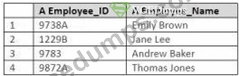
In the Learner Data TBL, Employee ID is numeric.
How can you prepare to join these tables, without the potential loss of data?
- A. Change the field type of Employee ID directly on the Learner Data TBL from Numeric to Text.
- B. Import the Learner Data TBL into a DDS and change the field type of Employee ID from numeric to text using a Manage Fields stage.
- C. Import the Employee Data TBL into a DDS and change the field type of Employee ID from text to numeric using a Manage Fields stage.
- D. Change the field type of Employee ID directly on the Employee Data TBL from text to numeric.
Answer: B
Explanation:
In Workday Prism Analytics, joining two tables requires that the fields used in the join condition have compatible data types to avoid data mismatches or loss. The Employee Data TBL has an Employee ID field as text, while the Learner Data TBL has an Employee ID field as numeric. According to the official Workday Prism Analytics study path documents, to join these tables without potential data loss, the best approach is to convert the numeric Employee ID in the Learner Data TBL to text, as text fields can safely store numeric values as strings, but converting text to numeric risks data loss if the text field contains non-numeric characters (e.g., leading zeros or special characters).
The correct method is to import the Learner Data TBL into a Derived Dataset (DDS) and use a Manage Fields stage to change the field type of Employee ID from numeric to text (option D). This ensures that the Employee ID field in both tables is text, enabling a safe and accurate join without losing data. The Manage Fields stage in a DDS allows for field type transformations, which is the recommended approach for preparing data for joins in Prism Analytics.
The other options are less suitable:
* A. Import the Employee Data TBL into a DDS and change the field type of Employee ID from text to numeric using a Manage Fields stage: Converting text to numeric risks data loss if the text field contains non-numeric values, which could lead to errors or missing records during the join.
* B. Change the field type of Employee ID directly on the Employee Data TBL from text to numeric:
Direct field type changes on tables are not supported in Prism Analytics, and even if possible, this approach risks data loss for the same reason as option A.
* C. Change the field type of Employee ID directly on the Learner Data TBL from Numeric to Text:
Direct field type changes on tables are not supported; field type transformations must be done in a DDS using a Manage Fields stage.
By converting the numeric Employee ID to text in a DDS, the join can be performed safely, preserving all data from both tables.
References:
Workday Prism Analytics Study Path Documents, Section: Data Prep and Transformation, Topic: Preparing Data for Joins in Prism Analytics Workday Prism Analytics Training Guide, Module: Data Prep and Transformation, Subtopic: Field Type Transformations Using Manage Fields Stage
NEW QUESTION # 47
An HR analyst is tasked to create custom reports for their company's performance reviews. The analyst uses both Workday and Prism for data analysis. What Workday-calculated field functions would the analyst be able to build off of their Prism object?
- A. Lookup Field with Prompts
- B. Arithmetic Calculation
- C. Lookup Related Value
- D. Extract Single Instance
Answer: B
Explanation:
Comprehensive and Detailed Explanation From Exact Extract:
In Workday Prism Analytics, when integrating with Workday reports, a Prism object (i.e., a published Prism data source) can be used as the basis for custom reports, and certain Workday-calculated field functions can be applied to it. According to the official Workday Prism Analytics study path documents, the Arithmetic Calculation function (option B) is a supported Workday-calculated field function that can be built off a Prism object. This function allows the analyst to perform mathematical operations (e.g., addition, subtraction, multiplication) on numeric fields within the Prism data source, such as calculatinga performance review score by combining multiple metrics. Since Prism data sources often contain pre-processed data, arithmetic calculations can be applied to enhance the data for reporting purposes.
The other options are not supported for Prism objects:
* A. Extract Single Instance: This function is used to extract a single instance from a multi-instance field in Workday, but Prism objects typically contain single-instance fields after transformations (e.g., via an Explode stage), making this function inapplicable.
* C. Lookup Related Value: This function retrieves related values from other Workday business objects, but Prism objects do not support direct lookups to Workday objects in this manner; such relationships must be pre-built in the Prism dataset.
* D. Lookup Field with Prompts: This function involves interactive prompting, which is not supported for Prism objects in Workday reports, as Prism data sources are static snapshots of data.
The Arithmetic Calculation function provides the flexibility to perform numerical computations on Prism data, making it a suitable choice for enhancing performance review reports.
References:
Workday Prism Analytics Study Path Documents, Section: Integrating Prism with Workday Reports, Topic:
Using Calculated Fields with Prism Objects
Workday Prism Analytics Training Guide, Module: Integrating Prism with Workday Reports, Subtopic:
Supported Calculated Field Functions for Prism Data Sources
NEW QUESTION # 48
You created a derived dataset that imports data from a table, which will become your Stage 1. What can you add to this dataset?
- A. As many transformation stages of any type as your scenario requires.
- B. Up to two Manage Fields transformation stages.
- C. Up to five transformation stages.
- D. As many transformation stages of any type as long as they are in a particular order.
Answer: A
Explanation:
Comprehensive and Detailed Explanation From Exact Extract:
In Workday Prism Analytics, a derived dataset (DDS) allows users to transform data by adding various transformation stages after the initial import stage (Stage 1). According to the official Workday Prism Analytics study path documents, you can add as many transformation stages of any type as your scenario requires (option A). Prism Analytics supports a variety of transformation stages, such as Join, Union, Filter, Manage Fields, and Calculate Field, among others. There are no strict limits on the number of stages or their types, and they can be added in any order that makes sense for the data transformation logic, as long as the stages are configured correctly to produce the desired output. This flexibility allows users to build complex transformation pipelines tailored to their specific use case.
The other options are incorrect:
* B. As many transformation stages of any type as long as they are in a particular order: While the order of stages matters for the transformation logic (e.g., a Filter before a Join), there is no predefined order requirement for all stages; the order depends on the scenario.
* C. Up to five transformation stages: There is no limit of five transformation stages in Prism Analytics; you can add more as needed.
* D. Up to two Manage Fields transformation stages: There is no restriction to only two Manage Fields stages; you can add as many as required.
The ability to add as many transformation stages as needed provides maximum flexibility in shaping the data within a derived dataset.
References:
Workday Prism Analytics Study Path Documents, Section: Data Prep and Transformation, Topic: Building Transformation Pipelines in Derived Datasets Workday Prism Analytics Training Guide, Module: Data Prep and Transformation, Subtopic: Adding and Configuring Transformation Stages
NEW QUESTION # 49
What task or report should you access to view a Prism data source?
- A. View Prism Data Source report
- B. Edit Dataset Transformations task
- C. View Dataset Details report
- D. Edit Data Source Security task
Answer: A
Explanation:
Comprehensive and Detailed Explanation From Exact Extract:
In Workday Prism Analytics, a Prism data source represents the published dataset that is available for reporting and analytics within the Workday ecosystem. According to the official Workday Prism Analytics study path documents, the "View Prism Data Source" report is the specific task or report designed to allow users to view the details of a Prism data source. This report provides comprehensive information about the data source, including its metadata, structure, and associated attributes, enabling users to understand the data available for reporting purposes.
The other options do not serve this purpose. The "Edit Dataset Transformations task" is used to modify the transformation logic applied to a dataset, not to view a data source. The "Edit Data Source Security task" focuses on managing security settings for a data source, such as access permissions, rather than viewing its contents. Similarly, the "View Dataset Details report" provides information about a dataset (including its metadata and sample rows) but does not specifically address the published Prism data source, which is a distinct entity created after a dataset is published.
The "View Prism Data Source" report is the correct choice as it directly aligns with the need to inspect the properties and structure of a Prism data source, ensuring users can verify its suitability for reporting or integration with Workday reports.
References:
Workday Prism Analytics Study Path Documents, Section: Datasets and Data Sources, Topic: Managing and Viewing Prism Data Sources Workday Prism Analytics Training Guide, Module: Publishing and Visualizing Data, Subtopic: Viewing and Validating Data Sources
NEW QUESTION # 50
The Prism use case is to classify workers based on their pay. You must create a field that evaluates worker pay and returns a value that represents various pay ranges. How would you add this field for inclusion on the Prism data source?
- A. Add the additional field to your raw data before you ingest into Prism.
- B. Build a CASE calculated field function on the TBL directly to ease later transformation.
- C. Create a derived dataset and build a CASE calculated field to classify workers against their pay.
- D. Build an Evaluate Expression calculated field on your final Prism business object to evaluate workers against their pay.
Answer: C
Explanation:
Comprehensive and Detailed Explanation From Exact Extract:
In Workday Prism Analytics, classifying workers into pay ranges based on their pay requires creating a new field that evaluates the pay values and assigns them to defined ranges (e.g., "Low," "Medium," "High").
According to the official Workday Prism Analytics study path documents, the recommended approach is to create a derived dataset (DDS) and build a CASE calculated field to classify workers against their pay (option B). The CASE function in a calculated field allows users to define conditional logic (e.g., CASE WHEN pay
< 50000 THEN "Low" WHEN pay < 100000 THEN "Medium" ELSE "High" END), which is ideal for creating pay range classifications. This calculated field is added within a deriveddataset, which can then be published as a Prism data source, making the new field available for reporting and analytics.
The other options are not optimal:
* A. Add the additional field to your raw data before you ingest into Prism: Modifying raw data outside Prism is unnecessary and less flexible, as Prism's transformation capabilities (like CASE) are designed for such tasks.
* C. Build a CASE calculated field function on the TBL directly to ease later transformation: Calculated fields cannot be created directly on a table (TBL) in Prism Analytics; they must be defined in a derived dataset.
* D. Build an Evaluate Expression calculated field on your final Prism business object to evaluate workers against their pay: Prism Analytics does not use "Prism business objects" for calculated fields, and "Evaluate Expression" is not a standard function; this option is not applicable.
Using a CASE calculated field in a derived dataset provides a flexible and maintainable way to classify workers by pay ranges, ensuring the field is included in the final Prism data source.
References:
Workday Prism Analytics Study Path Documents, Section: Data Prep and Transformation, Topic: Creating Calculated Fields with CASE Functions Workday Prism Analytics Training Guide, Module: Data Prep and Transformation, Subtopic: Classifying Data Using Calculated Fields in Derived Datasets
NEW QUESTION # 51
......
We offers you the latest free online Workday-Prism-Analytics dumps to practice: https://prep4sure.vcedumps.com/Workday-Prism-Analytics-examcollection.html
